
Understanding Quitman County Jail Releases
A local release means the Quitman County Sheriff's Office has ended one period of jail custody. It does not always mean the person walked free in Georgetown. A person may leave after posting bond, completing a sentence, receiving a court order, entering probation, or being transferred to GDC or another authority. The sheriff's discharge entry identifies that local event. A later state-prison or federal release is a separate event with a separate record.
Released people normally disappear from a current-custody roster because that tool answers who is confined now. No official public Quitman County roster or rolling release feed was confirmed during the official site sweep. The durable local source is the sheriff's jail record. Georgia law requires that record to preserve the discharge day, discharge order, and issuing court, even when no public web page displays them.
Four release terms
Discharge ends a particular custody entry. Transfer moves custody to another agency. Probation is court-ordered community supervision. Parole is conditional release from a state sentence under the parole system.
Quitman County Release Paths
The next lookup depends on how the person left custody. The same name may appear in more than one system as the case moves from arrest through sentence and release.
| Release path | What it means | Best next record |
|---|---|---|
| Bond or court order | The jail acts on an order or approved bond. | Sheriff discharge entry and Magistrate or Superior Court file |
| Time served | The ordered local term or credited time ends. | Sheriff record and sentencing court order |
| Probation | The court permits community supervision. | Court sentence and DCS Donalsonville office |
| Transfer to GDC | Local jail custody ends but state custody begins. | GDC Find an Offender |
| Parole from GDC | The Board authorizes conditional state release. | GDC actual release, Parolee Database, and DCS |
| Federal or immigration move | A federal agency takes or ends custody. | BOP locator or ICE locator, as applicable |
A transfer is the most important source of false assumptions. A Quitman County discharge can be accurate while the person remains confined elsewhere. Ask for the destination whenever the local record does not say the person was released to the community.
Fields in a Quitman County Release Record
O.C.G.A. 42-4-7 requires the sheriff to keep a record for each person committed to the county jail. The statute names the commitment date, discharge day, discharge order, and the court from which the order issued. Other practical fields may exist if the office maintains them. Requesting exact fields produces a clearer answer than asking generally for “inmate information.”
| Field | What it shows |
|---|---|
| Full name and identifying data | Connects the entry to the correct person, especially when names are similar. |
| Booking or commitment date | Marks when this local custody period began. |
| Charge and booking number | Ties the jail entry to the arrest and court matter when maintained. |
| Discharge day | Confirms when the local jail entry ended. |
| Discharge order | Identifies the authority or basis used to end local custody. |
| Issuing court | Points to the court file that can explain bond, sentence, dismissal, or another order. |
| Release type or bond data | May distinguish bond, sentence completion, or another result if maintained. |
| Transfer destination | Shows the next agency when the person did not leave custody entirely. |
The record does not by itself prove that every case obligation ended. Court dates, probation, parole, fines, restitution, or another hold may remain. Read the discharge entry together with the court disposition and any supervision record.
Request Quitman County Discharge Records
The Quitman County Sheriff's Office is the local custodian. The county contact table and Georgia Sheriffs' Association list the office at PO Box 338, Georgetown, GA 39854, with phone 229-334-3739 and fax 229-334-0905. A phone call can check status, but a written request is the stronger path for a copy.
- Identify the person by full legal name, date of birth if known, and an approximate booking or release range.
- Ask for the jail commitment and discharge record under O.C.G.A. 42-4-7, not merely a current inmate search.
- Name the fields needed: commitment date, discharge day, order, issuing court, charge, booking number, release type, and destination if transferred.
- Send the request to the sheriff and keep a copy. Ask how copies can be delivered and whether an estimate or prepayment applies.
- Use the issuing court or destination in the response to continue the search when the local record is not the final custody event.
Quitman County Sheriff's Office
PO Box 338
Georgetown, GA 39854
Phone: 229-334-3739
Fax: 229-334-0905
Under O.C.G.A. 50-18-71, available records must be produced within a reasonable time not exceeding three business days. If they cannot be produced then, the agency responds with their availability and timetable. The law permits up to ten cents per letter or legal page, actual cost for other media, and reasonable search, retrieval, redaction, and production charges after the first quarter hour. Higher-cost work may require prepayment.
Note: The three-business-day rule governs the response process and does not promise that every requested record will arrive within three days.
Georgia Law Behind Quitman County Releases
The statutory jail record is more useful after release than a short-lived roster. O.C.G.A. 42-4-7 places the recordkeeping duty on the sheriff and specifies the discharge fields. O.C.G.A. 42-4-4 supports the sheriff's custody role. The Georgia Open Records Act supplies the procedure for asking to inspect or copy records.
Court record restriction is a different process from jail discharge. Georgia does not use a single broad adult “expungement” label for every case. Record restriction may limit access to eligible criminal-history information, while sealing can apply to qualifying court material. Neither step should be assumed to erase every lawful agency record automatically. The Clerk of Superior Court or an attorney can explain the process for a particular court file.
Getting Home After a Quitman County Release
Geography creates a practical trap. Quitman County's seat is Georgetown, while the City of Quitman is in Brooks County. A pickup arranged only for “Quitman, Georgia” can go to the wrong county and the wrong jail. Confirm that the agency is the Quitman County Sheriff's Office in Georgetown before setting a destination or calling for status.
The official government uses the name Consolidated Government of Georgetown-Quitman County. That is why local pages use the `gqc-ga.org` domain and may not resemble a typical standalone county jail portal. The Georgia Sheriffs' Association directory is a useful second check because it separately lists Quitman County in Georgetown and Brooks County in the City of Quitman.
Bond Orders and Quitman County Release
Short local stays often end through the magistrate process rather than a published release list. The Quitman County Probate and Magistrate Court page says the magistrate approves and signs warrants. The office, led by Judge L. Matthew Self, can be reached at 229-334-2224. A bond or first-stage court order can cause a person to leave the jail even when no release entry is visible online.
For misdemeanor and felony files handled in Superior Court, the clerk manages warrants, accusations, indictments, and related records. The court order can explain why custody ended, while the sheriff's entry confirms that the order was carried out. These records answer related but different questions.
Search for a Released Quitman County Inmate
There is no single Quitman County search that covers local jail, state prison, parole, federal custody, and court disposition. Follow the path in the order that matches the known custody.
- Call the Quitman County Sheriff's Office for a current-status check and request the local commitment and discharge record for a past jail stay.
- If the person may have entered state custody, search GDC by name, GDC ID, or case number and inspect current status plus actual release date.
- Check the issuing court for the release order, disposition, sentence, or probation terms. The clerk's file lasts beyond the jail stay.
- Use the parole board's TPM tool only for tentative pre-release review and its Parolee Database after parole release. Contact DCS for local supervision.
- Use Georgia VINE for a custody-change alert, but verify an alert with the agency that owns the record.
- For federal or immigration custody, use the BOP or ICE locator rather than the county sheriff or GDC.
Why is the person gone from the roster? A live roster is built for current custody. Discharge or transfer removes the person, so the historical trail shifts to the sheriff's record, court file, or receiving agency.
For a same-day status question, the Jail Releases: 24 Hours guide explains the local fallback when no public feed exists. It is not a substitute for the named-person search above.
GDC Search for Quitman County Releases
The Georgia Department of Corrections Find an Offender search is the correct public path for a person who entered state custody. Search by GDC ID, case number, or name. Age, race, sex, and conviction county help separate similar names. A brief Quitman County jail stay that never became a GDC sentence may produce no result.
| GDC field | How to read it |
|---|---|
| Current status | Inactive supports a past state-custody result; active means state custody or sentence status continues. |
| Max possible release date | The projected maximum on the state record, not proof of actual release. |
| Actual release date | A past date paired with inactive status is the public state-release signal. |
| Most recent institution | Identifies the state institution tied to the latest period. |
| Sentence detail | Connects the record to conviction and term information. |
| Incarceration history | Shows state custody events over time. |
The official screen below shows the entry point and the identifiers GDC accepts.
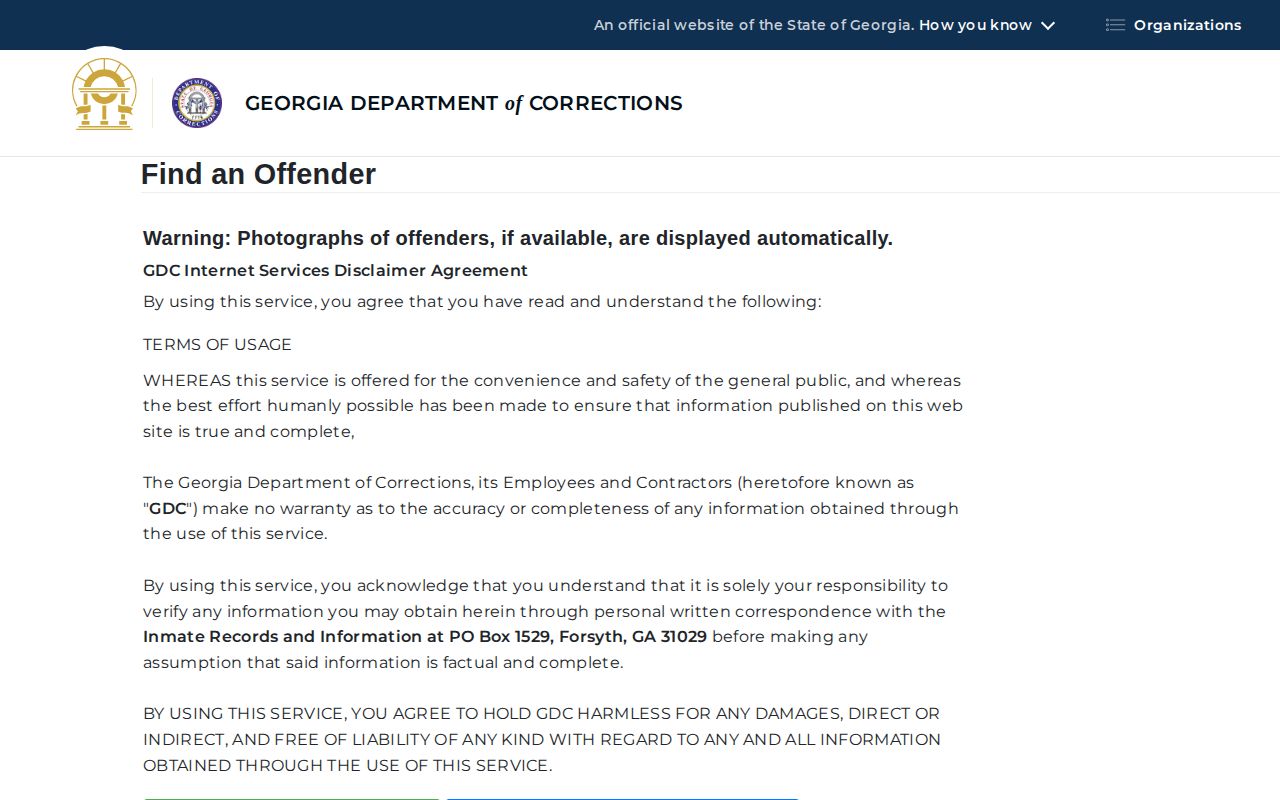
The search is a locator, not a certified release record. GDC directs written verification to Inmate Records and Information, PO Box 1529, Forsyth, GA 31029.
Correcting Quitman County Release Errors
An error must go to the system that displays it. A wrong local discharge day belongs with the sheriff because it appears in the O.C.G.A. 42-4-7 jail record. A wrong GDC actual-release date belongs with GDC Inmate Records and Information. A parole status problem goes to the Board or DCS, and a mistaken disposition goes to the court clerk.
Send the agency enough detail to locate the entry and state which field appears wrong. Include the full name, identifying number if known, relevant dates, and a copy or description of the conflicting official record. Asking one office to “fix the inmate search” is unlikely to work because Quitman County has no unified search.
Court Records Explain Quitman County Releases
Court interplay matters more here because no public local roster was captured. The Quitman County Clerk of Superior Court says the office manages misdemeanor and felony records, including warrants, accusations, and indictments. The Magistrate Court approves and signs warrants. A docket entry, bond order, dismissal, sentence, or probation order may therefore explain a release that has no public jail page.
Georgia Courts E-Access points users to online court services, and re:SearchGA covers participating electronic records. Availability can differ by court and case. Contact Clerk Rebecca S. “Becky” Fendley at 229-334-2578 when the needed Quitman County file is not available through the online path.
Quitman County Release Alerts and Federal Records
Georgia VINE can send custody-change notifications through phone, online, and mobile channels when a participating feed contains the person. A released or transferred alert is a prompt to verify, not the underlying legal record. Confirm a local result with the sheriff and a state result with GDC. A missing VINE result does not establish release.
The BOP inmate locator covers federal inmates from 1982 forward. “Released” or “Not in BOP Custody,” a past release date, and no location indicate the person is no longer in BOP custody, though another authority or supervision may remain. ICE's locator is for immigration custody and requires identifying details such as name, country of birth, date of birth, or A-number. Neither system is a Quitman County jail discharge record.
Where Quitman County Release Status Appears
Match the question to the system before interpreting a missing name. Each source covers one part of the custody trail.
| System | Still in custody | After release |
|---|---|---|
| Quitman County jail | Confirm directly with sheriff; no public roster was found. | Request commitment and discharge record. |
| GDC | Active status and institution identify state custody. | Inactive status with actual release date supports state release. |
| PAP and DCS | TPM may describe future parole review. | Parolee Database and DCS identify parole supervision. |
| Court | Orders can explain bond or continued detention. | Disposition and sentence records outlast custody. |
| BOP or ICE | Federal locator may identify federal custody. | BOP past release data can show federal release; ICE absence alone is not proof. |
Quitman County Jail and Release Records
The Facility Map identifies one local detention function: the Quitman County Jail operated through Sheriff Charles Davis's office in Georgetown. People released to the community leave through the sheriff's process. People transferred to GDC, another county, or a federal authority require a second lookup in the receiving system.
The consolidated Georgetown-Quitman County identity can make the facility harder to recognize in search results. Historical courthouse or jail references are not the operating release channel. Current status and record requests belong with the present sheriff's office and the relevant court.
Public Record Search
Sponsored Results