
Quitman Projected vs Actual Release
Georgia records use three labels that should never be blended. GDC's MAX POSSIBLE RELEASE DATE is a sentence-expiration calculation. The ACTUAL RELEASE DATE, paired with CURRENT STATUS: INACTIVE, indicates that the person left GDC custody on the listed sentence. The Board of Pardons and Paroles uses Tentative Parole Month, or TPM, for possible parole timing before a final review.
A TPM is not a promise. PAP may advance, delay, cancel, or condition it. An active record that says CURRENTLY SERVING does not show a completed release even if a future maximum date appears.
Find Quitman County Release Dates
Match the lookup to the custody system. Quitman County Jail records and court orders control local detention. GDC records control state-prison sentences. PAP records address parole consideration.
- Confirm whether the person is in the county jail, state prison, federal custody, or already released.
- For GDC custody, use Find an Offender. Search by name, GDC ID, or case number and use age, race, sex, and conviction county to distinguish similar names.
- Read maximum possible release, actual release, current status, sentence details, and incarceration history together.
- For parole timing, check the Inmate TPM Lookup by the supported inmate identifiers or personal data.
- For a county-jail term, ask the sheriff and sentencing court for the commitment, sentence, credit, hold, and discharge record.
The Quitman County release-record hub covers the local discharge request when no online jail roster is available.
The official TPM source shows where parole timing is checked.
Open the Georgia Inmate TPM Lookup source.
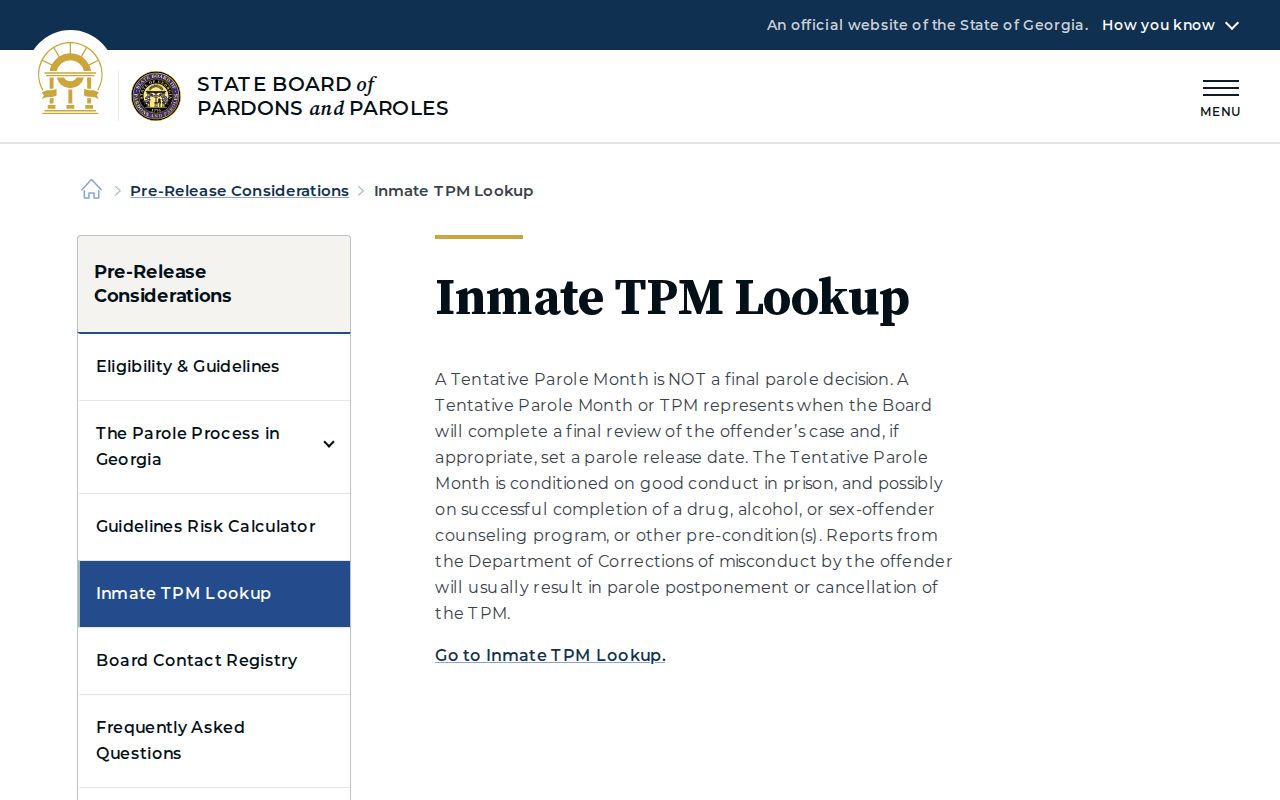
The screenshot reinforces that TPM belongs to parole consideration, not final release confirmation.
Georgia Credit and Parole Timing
The captured Georgia material does not support a blanket statement that every prisoner serves one fixed percentage. O.C.G.A. 42-9-45 addresses parole eligibility. For many parole-eligible felony sentences, eligibility begins after nine months or one-third of the sentence, whichever is greater, subject to statutory exceptions. Eligibility only permits consideration. It does not set the release day.
PAP's Performance Incentive Credit program can advance an eligible person's TPM by a few months for satisfactory education, treatment, work, and conduct. Poor performance can add time to a TPM. Several categories are excluded, including life sentences, certain short sentences, and cases without a TPM. This program changes tentative parole timing, not the GDC actual-release record.
A Quitman County jail sentence is separate. The court order, credit for time served, sheriff's jail record, and applicable rules control local computation. GDC maximum-date and PAP TPM fields apply only if the person enters the state system.
Why Quitman Release Dates Change
A future date can move because sentence math and release authority are not the same thing. Read any change with the current status and source agency.
| Factor | Possible effect | Confirm with |
|---|---|---|
| Parole decision | Earlier release, delay, denial, or conditions | PAP |
| Program or conduct | TPM advanced or delayed for eligible cases | PAP and GDC |
| Detainer or hold | Transfer to another authority instead of community release | Holding agencies |
| Court order | Sentence changed, credited, or otherwise resolved | Sentencing court |
| New sentence data | Maximum calculation or custody status updated | GDC |
A detainer is a request by another authority to hold or transfer the person. Departure from one jail can therefore be a transfer, not freedom from custody.
Confirm Quitman County Release
Use VINELink Inmate Search to register for a custody-change alert where the agency feed covers the person. An alert is useful, but it is not the final legal record. Confirm a county-jail release through the sheriff's discharge entry. Confirm a state-prison release through GDC's actual-release and inactive-status fields. Confirm parole through PAP and DCS.
Federal custody belongs in the BOP locator, and immigration detention belongs in ICE systems. A missing Georgia result may mean transfer, a different spelling, another county, or a system outside Georgia VINE. Never infer release from absence alone.
Three Georgia Release Labels
The local computation quirk is not a Quitman formula. It is a three-source problem. Maximum possible release comes from GDC sentence data. Actual release confirms an event that already occurred. Tentative parole month comes from PAP's discretionary review process.
PAP explains that a TPM can depend on good conduct, program completion, and an acceptable release plan. Misconduct can delay or cancel it. For life-sentence cases, the Board decision is generally grant or deny rather than a TPM. The cleanest record check preserves each label exactly and notes its agency and retrieval date.
Quitman Jail Release Timing
A person held before trial may leave through bond, dismissal, a court order, transfer, or another legal event. There is no fixed projected date in the same sense as a sentenced GDC record. The Quitman County Probate and Magistrate Court handles warrant and early-stage matters, while superior court records can explain felony disposition and sentence terms.
No official public Quitman County jail roster or projected-date portal was captured. Ask the sheriff whether the person remains in custody and ask the court for the controlling order. Under O.C.G.A. 42-4-7, the jail record includes commitment and discharge facts such as the discharge day, order, and issuing court. Those fields document an event rather than predict a pretrial release.
For a local sentence, request the sentence, time-served credit, holds, and discharge entry. If the person transfers to GDC, switch to the state offender record. A county-jail release to GDC is not community release and must not be confused with a later GDC discharge.
Read Quitman Release Fields
GDC results provide more than one date. Review name, GDC ID, year of birth, major offense, most recent institution, current sentences, prior sentences, and incarceration history. Physical details and aliases help distinguish common names. Current status is vital because a date copied without status can be misunderstood.
An inactive record with a past actual-release date is the public indication that the person left GDC custody on that sentence. It does not rule out parole supervision, a new booking, or transfer. An active record with "currently serving" means state custody continues. GDC directs users to verify information through Inmate Records and Information at P.O. Box 1529, Forsyth, GA 31029.
Time served is credit for qualifying custody before or during the sentence. Informal arithmetic can miss concurrent or consecutive terms, sentence amendments, and credited custody. Use the official field and signed sentence instead of calculating from a charge list.
Plan Around Tentative Dates
Do not arrange a pickup solely from a maximum date or TPM. Wait for confirmation from the holding agency and the person or authorized contact. A plan can change due to transport, a detainer, paperwork, misconduct, program completion, or final Board action.
PAP may require a suitable residence or another condition before parole takes effect. Outstanding charges can lead to parole to a detainer. Georgia VINE can add an alert where coverage exists, but the alert remains supplemental to the sheriff, GDC, PAP, and DCS records.
Georgia Parole Date Review
The Board automatically considers eligible GDC felony inmates under its process. Staff conduct pre-parole investigation and review legal history, personal history, GDC summaries, and information from victims, prosecutors, judges, and the public. The result may be a TPM, denial, or later reconsideration. Life-sentence cases generally receive a grant or deny decision rather than a TPM.
PAP's decision guidelines are a framework, not a personal release calendar. The Board may accept or reject a guideline recommendation. It may condition a TPM on conduct, programming, or an acceptable residence. It can advance timing for exceptional conduct or delay and cancel timing for misconduct.
Public Board meetings do not decide individual cases in an open session. Press releases and meeting notices describe policy and operations. For one person, use the TPM lookup before release, the GDC record for state custody, and the parolee database after release. This avoids reading a general meeting date as an inmate's hearing date.
Parole eligibility under O.C.G.A. 42-9-45 is also not release approval. For many eligible felony cases, the general threshold is nine months or one-third of the sentence, whichever is greater, unless another rule applies. Serious offenses and other categories have separate limits. Only the Board's case action can establish the parole outcome.
Quitman Release Verification Chain
Start with present custody. The sheriff handles a local jail record. GDC handles a state-prison record. BOP handles federal custody, and ICE handles immigration detention. A person absent from one system may have moved to another, so the search should follow the transfer rather than assume freedom.
Next, compare the court order with the agency fields. For local custody, request the discharge day, discharge order, and issuing court. For GDC, compare maximum possible release, actual release, current status, and incarceration history. For parole, preserve the TPM as tentative until a final date or parolee status appears.
Finally, use a dated alert as a prompt to verify. VINELink can report a custody change from a participating feed, but status labels vary. Call or write the record owner for confirmation. This chain answers both when release may occur and whether it actually occurred.
Detainers and Quitman Release Dates
A detainer gives another authority a path to take custody. It can change what happens at the end of a jail or prison term without changing the fact that one agency's custody ended. PAP may parole a person to a detainer, and a Quitman County discharge may record a transfer rather than return to the community.
Ask whether a hold or destination appears in the public record, then search the receiving system. A state transfer belongs in GDC, a federal prison matter belongs in BOP, and immigration detention belongs in ICE. The sheriff cannot confirm the final release date of someone who moved into another system.
Court orders can alter sentence credit or custody. Obtain the signed order and compare it with the agency fields. When dates conflict, request written verification from the record owner instead of choosing the earliest date.
Recheck Quitman Release Timing
Recheck near the expected date because a maximum date or TPM can move. Preserve each result with the date accessed, status label, and agency name. That makes it easier to identify whether a change came from GDC, PAP, the court, or a transfer.
After the date passes, look for an actual-release field and inactive status. If neither appears, contact GDC Inmate Records and Information. For local custody, ask the sheriff for the discharge entry rather than calculating from the arrest date.
Public Record Search
Sponsored Results